April 3 – 19, 2026
Official PRCA rules, regulations, and event descriptions
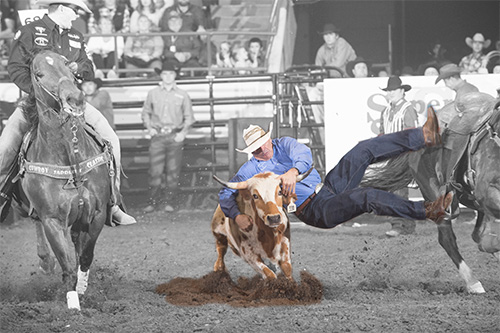
Drop from a horse, grab a steer by the horns and wrestle it to the ground. It may seem like a simple concept, however, coordination between a steer, two cowboys and two horses requires impeccable timing, technique and strength. The steer wrestler begins by backing into the box on the left side of the steer. The race is on at the cowboy’s nod! Both the steer wrestler and his hazer, the person guiding the steer in a straight path, set out parallel to obtain the best position. The cowboy dismounts when even with the steer by dropping from his horse, positioning his right arm around the right side of the steer while the left hand grabs the inside horn. Once dismounted, the steer wrestler digs his heels into the dirt to stop the forward acceleration of the steer in order to lay it on its side with all four legs pointed in the same direction. Time begins when the cowboy leaves the box. The flag judge on horseback in the arena will drop his flag when the steer is down and the clock stops.
The goal is to throw a bell collar catch around the calf’s neck. Immediately upon snagging the calf, the roper’s horse slams on the brakes, cinching the rope taut. When this happens, the string that ties the rope to the saddlehorn breaks and this signals the end of the run. When the string breaks, the clock stops.
The roper backs his horse into the box with a rope in one hand and his “piggin string” in his mouth. When the calf settles and the cowboy nods, the chutes open. The calf gets a running start while the cowboy chases him down the arena. He throws a loop over the calf’s head, and stops the horse pulling the rope taut. The cowboy jumps off and runs down the rope anchored to the saddle horn, lays the calf on the ground and uses his “piggin string” to tie any three of the legs together. The field judge drops the flag and stops the clock when the cowboy has securely tied three legs and lifts his hands away from the string to show he is finished. But its not over yet… the cowboy must remount his horse, ride forward and the calf must remain tied for six second for the run to qualify.
Rodeo’s only true team event, team roping requires precise timing and anticipation between the header and heeler. The mounted cowboys back their horses into the “box.” The header nods his head and the gates open. Two cowboys use different skills and differently trained horses to gain control of the running steer. The header throws the first loop in an attempt to rope the steer around the horns, neck or a horn-neck combination. He then dallies, wraps the rope around his saddle horn, and rides to the left, changing the direction of the steer to the left. This gives the heeler the opportunity to ride in and rope both of the steer’s hind legs. After the catch, the heeler also dallies to stop the steer. When the horses turn to face the steer the time is recorded by the flagging judge in the arena. The line judge stays by the box to ensure the steer gets the proper head start and the mechanical barrier is not broken.
Each bareback rider brings his own “riggin,” a customized suitcase-style handheld grip attached to a piece of leather and cinched with a pad around the horse’s girth. The cowboy secures one gloved hand inside his riggin, while his other arm deemed his “free hand” may not be used in his ride. A previous random draw lets the cowboy know his horse mount and when he nods, the chute gate opens. Upon exit of the chute, the cowboy’s feet must be above the break of the horse’s shoulder through the horse’s first jump before setting into a methodical spurring pattern with his toes turned out. If the ride lasts the required 8 seconds it is then scored by two judges located inside the rodeo arena, who assesses the difficulty and control. Each judge may award 25 max points to the rider for spurring ability and technique, and 25 max points for the animal’s bucking performance, for a 100 point potential score. One of the most physically demanding and wildest events in rodeo, it all comes down to the “luck of the draw!”
Unquestionably rodeo’s most thrilling, unpredictable, and dangerous event lies in bull riding. A random draw lets the cowboy know his bull. He settles on the animals back, wraps a braided rope around the bulls girth, secures his palm in a handhold, grips tightly and holds on for what he hopes is an eight second ride. When the cowboy nods, a charging bull explodes out of the chute gate jumping, spinning and lunging in an attempt to eject the cowboy. If the ride lasts the required 8 seconds it is then scored by two judges located inside the rodeo arena, who assesses the difficulty and control. Each judge may award 25 max points to the rider for spurring ability and technique and 25 max points for the animal’s bucking performance, for a 100 point potential score. This event requires the toughest and most courageous cowboys in an intense match up of man meets a one ton raging bull.
This is the classic old west event of rodeo, offering a match-up between top cowboys looking to climb atop a rank bucking horse that has never taken to a saddle ride. A previous random draw lets the cowboy know his mount and with his nod, the chute gate opens. Upon exit of the chute, the cowboy”s feet must be above the break of the horse’s shoulder through the first move. A synchronized spurring with the horse’s jumps will lead to a higher score. The cowboy secures one hand to a 6-foot braided rope while his other arm deemed as his “free hand” may not be utilized in the ride. If the ride lasts the required 8 second it is then scored by two judges located inside the rodeo arena, who assesses the difficulty and control. Each judge may award 25 max points to the rider for spurring ability and technique, and 25 max points for the animal’s bucking performance, for a 100 point potential score. If the cowboy makes a complete 8 second ride, two mounted pickup men then move in to assist the cowboy to a safe dismount. This classic, crowd pleasing event also comes down to the “luck of the draw” leading to an intense competition between man and horse.